
How to Choose a Tree Surgeon in Manchester
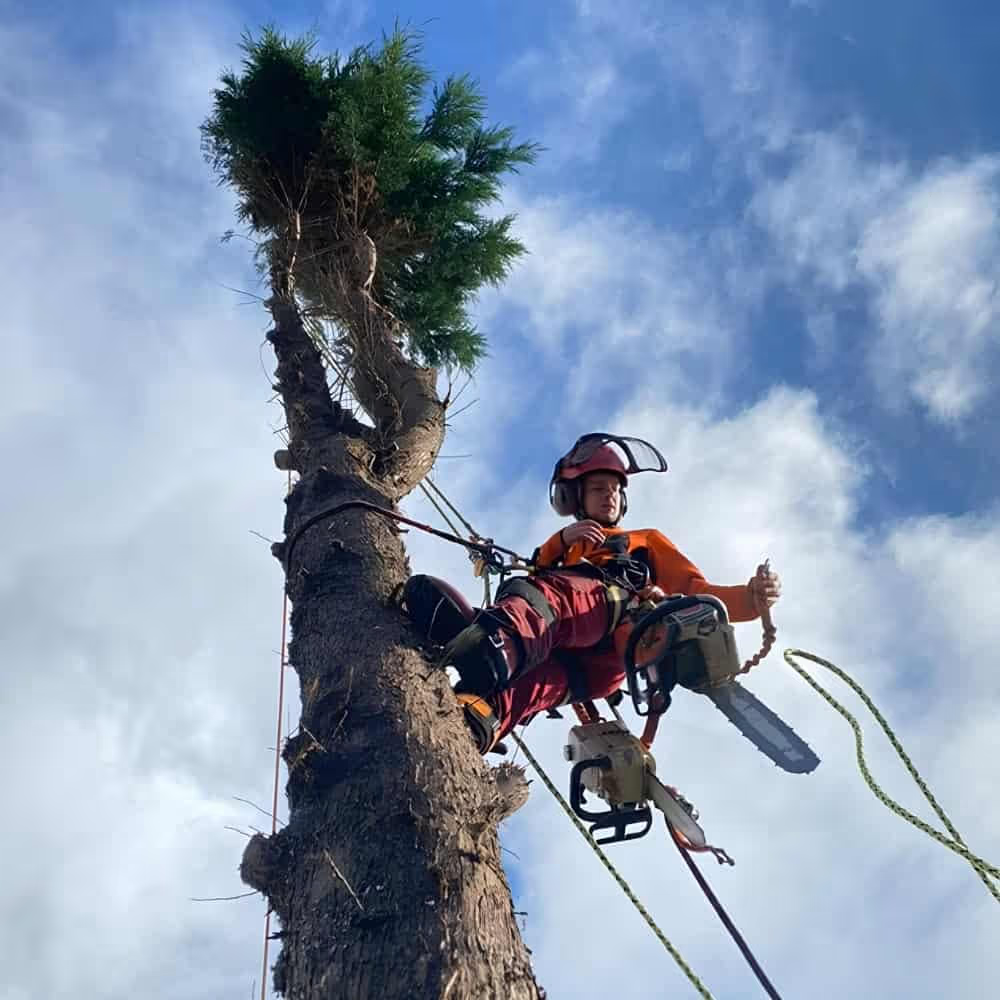
How to Choose a Tree Surgeon in Manchester
Choosing a tree surgeon in Manchester is not just about finding someone with a chainsaw and a van. Tree work is skilled, hazardous, and easy to get wrong. Poor work can injure people, damage property, harm the tree, and leave you exposed if protected-tree permission or waste disposal has not been handled correctly.
The Arboricultural Association advises clients to ask direct questions about insurance, qualifications, recognised standards, written quotations, references, and protected-tree responsibilities. Its guidance also notes that tree work is not directly regulated, which means a person can offer tree surgery services even without the right credentials. That is why your checks matter.
Quick answer
A competent tree surgeon in Manchester should be able to show current public liability insurance, relevant National Proficiency Tests Council or Lantra Awards certificates, a clear written quotation, and an understanding of British Standard 3998:2010 Tree work. Recommendations. They should also check whether your tree is protected by a Tree Preservation Order or conservation area rules before starting work.
A good contractor explains the method.
A poor one only gives a price.
If you are comparing quotes, compare the specification, not just the total.
Why choosing the right tree surgeon matters
Tree surgery often looks simple from the ground. It isn’t.
A crown reduction over a conservatory, a tree felling beside a drive, or an emergency tree removal after a storm all involve judgement. The climber needs to understand loading, anchor points, decay, branch attachment, escape routes, lowering systems and the likely response of the tree after pruning.
The Health and Safety Executive states that chainsaws can cause fatal or major injuries if not used correctly, and that anyone using a chainsaw at work must have adequate training and competence for the work they are required to do. Its guidance also records deaths and serious injuries linked to chainsaw operations in forestry and arboriculture.
In the North West we often find added complications: wet summers, saturated lawns, narrow side access, clay soils, roadside belts, boundary walls, overhead lines, parked cars, public rights of way, and gardens where a simple fell is impossible. In those situations, good planning is not an optional extra. It is the job.
If the tree is beside a play area, road, footpath, drive or neighbouring property, use a properly qualified tree surgeon.
What a competent tree surgeon should be able to prove
Insurance
Ask to see insurance before you accept the quote.
The Arboricultural Association says a reputable contractor should be happy to show insurance, including public liability insurance and employers’ liability insurance where the contractor has employees. It recommends minimum public liability cover of five million pounds.
Check the name on the insurance document. It should match the trading name or company you are instructing. Also check the expiry date and the type of work covered. Tree climbing, dismantling, rigging and commercial tree services should not be treated as casual gardening.
Practical line: ask for the insurance certificate before the work is booked.
Qualifications and chainsaw competence
Ask who will actually do the work, not just who came to quote.
Relevant certificates commonly include chainsaw maintenance, small tree felling, aerial tree work, tree climbing, aerial rescue, rigging and advanced chainsaw use. The Arboricultural Association identifies National Proficiency Tests Council and Lantra Awards as common routes for proving chainsaw and tree-climbing competence.
Certificates are not the whole story. They prove training and assessment. They do not prove judgement, care, or years of good decision-making. That is why references, photographs of similar work, professional membership, and the quality of the written quotation all matter.
The Health and Safety Executive also says tree-climbing operations should only be performed by people with suitable training, experience and expertise, and that a second person must be available who is equipped, trained and capable of aerial rescue.
Practical line: ask who is climbing, who is supervising, and who can carry out aerial rescue.
British Standard 3998
A professional tree surgeon should be comfortable talking about British Standard 3998:2010 Tree work. Recommendations.
British Standard 3998 is the principal United Kingdom standard for tree work recommendations. The British Standards Institution describes it as current and lists it as covering tree surgery, pruning, occupational safety, protective clothing, nature conservation, management of established trees, and related arboricultural matters.
For a householder, the key point is simple: tree work should be specified. “Cut it back” is not a good specification. “Reduce the crown height and lateral spread by approximately two metres, pruning back to suitable growth points while retaining the natural form of the tree” is much better.
Poor pruning has lasting consequences. Research on mature urban trees found that topping and severe pruning can increase dieback and future risk, whereas reduction to suitable lateral growth can be less disruptive to tree growth.
Practical line: if the quote does not say how the tree will be pruned, ask for a clearer specification.
Written quotation
Do not rely on a verbal price.
The written quotation should state:
- Which tree or trees are included.
- The exact work specification.
- Whether timber, brash and arisings will be removed.
- Whether stump grinding is included.
- Whether Value Added Tax is included.
- Who checks tree protection status.
- Who submits any required permission.
- How the site will be protected and left.
- Whether traffic, pedestrian or access control is needed.
- Whether specialist equipment is included.
The Arboricultural Association specifically advises clients to ensure the quote is in writing and to check that it includes the specification, what happens to arisings, stump details, legal constraints and whether the cheapest quote is genuinely the best choice.
A good quotation should answer these questions without you chasing
What is being done?
Why is it being done?
How will it be done safely?
What will the tree look like afterwards?
What happens to the waste?
What permissions are needed?
Practical line: if two quotes cannot be compared like for like, ask both contractors to clarify the specification.
Manchester tree work: local checks before anyone starts cutting
Tree Preservation Orders and conservation areas
Before pruning, felling, crown reduction, sectional tree removal or emergency tree removal, check whether the tree is protected.
Government guidance says a Tree Preservation Order can protect individual trees, groups of trees or woodlands, and that it prohibits cutting down, topping, lopping, uprooting, wilful damage and wilful destruction without written consent from the local planning authority.
Manchester City Council states that consent is required before a tree covered by a Tree Preservation Order may be pruned or felled. It also states that anyone wishing to fell, prune or uproot trees in a conservation area must give six weeks’ notice unless the tree forms a public safety hazard or is already covered by a Tree Preservation Order.
This is where a competent tree surgeon should slow the conversation down. A protected tree can often still be managed, but the work must be justified, specified and authorised. A rushed job can create trouble for the tree owner as well as the contractor.
Practical line: check tree protection status before you accept a start date.
Waste removal and site tidiness
Tree work creates arisings: branches, brushwood, logs, sawdust, rakings and sometimes stump grindings.
If you expect all material to be removed, the quotation should say so. If you want logs left for firewood, say so. If you want the stump ground out, do not assume it is included.
The Environment Agency says anyone who moves waste as part of their business operations must register with the relevant regulator, including those who transport waste, buy or sell waste, or arrange waste disposal. The Environment Agency also operates a public register of waste carriers, brokers and dealers.
Practical line: ask where the waste is going and whether removal is included in the price.
Why the cheapest quote is not always the best quote
Cheap tree work often becomes expensive when the detail is missing.
A low quote may exclude waste removal, stump grinding, permission work, traffic management, specialist access equipment, rigging time, extra labour, or proper site protection. It may also reflect a rushed method that increases risk to people, roofs, greenhouses, fences, lawns, drains, garden rooms and neighbouring land.
A proper tree surgery quote prices the risk and the method. That is especially important in Manchester gardens where access can be tight, rear gardens may only be reached through the house or a narrow passage, and roadside trees often need pedestrian control.
Pros of a cheaper quote:
It may be suitable for simple, low-risk work.
It may be competitive where access is easy.
It may be fair if the contractor has low overheads but good standards.
Cons of a cheaper quote:
It may omit important items.
It may not include waste removal.
It may rely on unsafe access.
It may not include proper insurance.
It may not protect the tree’s long-term structure.
It may leave the owner dealing with council or neighbour issues.
A good tree surgeon will not be offended by detailed questions. They will usually welcome them.
Practical line: choose the quote that best explains the work, not the one that hides the most detail.
When specialist methods are needed
Sectional tree removal
Sectional tree removal is used when a tree cannot be felled safely from ground level. Instead, the tree is dismantled in controlled sections. This is common where trees stand near houses, garages, conservatories, roads, footpaths, sheds, fences or neighbouring gardens.
In places such as Chorlton, Didsbury, Stockport, Salford, Trafford, Prestwich and Glossop, we often see mature trees in tight domestic spaces where straight felling is not realistic. Sectional dismantling gives control.
Practical line: if there is no clear drop zone, ask whether sectional dismantling is needed.
Rigging branches
Rigging is the controlled lowering of branches or stem sections using ropes, pulleys, friction devices and trained ground staff. It is not just “throwing a rope over a branch”. It requires judgement about weight, force, anchor points, communication and escape routes.
The Health and Safety Executive notes that sectional felling stems should use appropriate attachment or anchor points, and that ground staff need to support and monitor the climber.
Practical line: if branches overhang a roof, greenhouse or public route, ask how they will be lowered.
Mobile Elevating Work Platform
A Mobile Elevating Work Platform can be a safer and more efficient option where climbing is unsuitable, especially if the tree is dead, storm-damaged, heavily decayed, or difficult to access safely by rope and harness.
The Health and Safety Executive says Mobile Elevating Work Platforms can provide safe and quick access to trees and a secure working platform, and that they should be considered when planning work at height.
Practical line: if the tree is too unsafe to climb, a platform may be the professional answer.
Crane-assisted tree removal
A crane may be appropriate where a large tree must be removed in sections and the site cannot safely accommodate normal lowering or dismantling. Crane work is specialist work. It needs planning, communication, lifting competence, exclusion zones and a clear understanding of loads.
It costs more for good reason. Done properly, it can reduce site damage, shorten high-risk exposure time and make difficult removals more controlled.
Practical line: if the tree is large, compromised or over valuable structures, ask whether a crane-assisted method has been considered.
Choosing a tree surgeon for domestic and commercial sites
For domestic clients, the main concerns are usually safety, cost, tidiness, neighbours, council permission and preserving the tree where possible.
For commercial tree services, the issues widen. Schools, housing associations, retail sites, industrial estates, care settings and managed estates need records, risk control, safe systems of work, public exclusion, timing around site users, and clear communication.
A contractor working on a commercial site should be able to provide risk assessments, method statements, insurance, training records, emergency arrangements and a programme that limits disruption.
A short vignette from local work: a large sycamore in a Manchester garden had been identified as potentially unstable, and the job involved council permission before removal. That sort of situation is exactly where a good contractor earns trust: inspect first, check consent, plan the removal, then complete the work without leaving the client exposed. Roots and Shoots Manchester describes this type of permission-led tree removal on its own tree surgery site.
Practical line: where trees affect people, access, roads or buildings, insist on a documented method.
Practical questions to ask before accepting a quote
Ask these before you say yes:
Will you provide a written quotation?
Are you insured for this type of tree work?
Who will carry out the climbing or cutting?
What certificates do the operatives hold?
Will the work follow British Standard 3998?
Is the tree protected by a Tree Preservation Order or conservation area rules?
Who is responsible for the application or notice?
Will arisings, logs and brushwood be removed?
Is stump grinding included?
Will the garden, drive, road or footpath need protection?
Is a Mobile Elevating Work Platform, crane or rigging system needed?
What will the tree look like afterwards?
Can you provide references or examples of similar work?
Two checks you can do yourself:
Take photographs from the same positions before the quotation, especially from the garden, drive, road and neighbour-facing side. They help everyone agree what has changed after the work.
Use your local council’s tree protection information before instructing work. If you are in Manchester, the council states that Tree Preservation Order consent is required before pruning or felling, and conservation area tree work normally needs six weeks’ notice.
Practical line: if the contractor cannot answer these questions clearly, keep looking.
Call to action
Need professional tree surgery in Manchester or the surrounding North West?
Roots and Shoots Manchester carries out tree felling, crown reduction, emergency tree removal, sectional tree removal, crane-assisted tree work and commercial tree services across Manchester, Greater Manchester and nearby areas. For independent tree inspections, mortgage tree reports, subsidence tree surveys or condition surveys, Tree Surveys North West can provide clear arboricultural advice before work is instructed.
Speak to a qualified professional before you cut. It protects you, your property, and the tree.
Frequently asked questions
How do I know if a tree surgeon is qualified?
Ask to see relevant National Proficiency Tests Council or Lantra Awards certificates for the work being carried out. For climbing work, you should expect evidence of climbing, aerial rescue and chainsaw competence, not just general gardening experience.
Should a tree surgeon have insurance?
Yes. Ask for public liability insurance, and employers’ liability insurance where staff are employed. The Arboricultural Association recommends a minimum of five million pounds public liability insurance.
What should be included in a tree surgery quote?
A good quote should include the tree location, the work specification, waste removal arrangements, stump details, Value Added Tax position, protected-tree responsibilities, site protection, access requirements and any specialist equipment.
Do I need permission to cut a tree in Manchester?
You may need permission if the tree is protected by a Tree Preservation Order or if it stands in a conservation area. Manchester City Council states that consent is required for work to trees covered by a Tree Preservation Order and that conservation area tree work normally requires six weeks’ notice.
Is crown reduction better than tree felling?
Sometimes. Crown reduction can reduce end weight, manage size and retain the tree, but it must be specified correctly and carried out to suitable growth points. Tree felling may be more appropriate where the tree is dead, structurally unsafe, unsuitable for retention or causing an unacceptable risk.
Why do tree surgery prices vary so much?
Prices vary because tree work is priced around risk, access, labour, waste, equipment, permissions and time. A tree over a lawn with clear access is different from a tree over a conservatory, public footpath or road.
Should I use a Mobile Elevating Work Platform for tree work?
Not always. A Mobile Elevating Work Platform is useful where it gives safer access, especially for unsafe, dead or storm-damaged trees. The Health and Safety Executive says these platforms should be considered when planning work at height.
Disclaimer
This article provides general guidance for tree owners in England. It is not legal advice, and it is not a substitute for a site-specific arboricultural inspection. Tree Preservation Order, conservation area, planning, wildlife and health and safety requirements can vary according to the tree, site, timing and local authority. Always check protected-tree status and use a suitably qualified and insured professional before instructing tree work.

Speak to a trusted professional tree surgeon about your trees
Whether you need advice, ongoing maintenance or professional tree work, we offer a free, no-obligation site visit to assess your trees and discuss the best course of action.