
Questions to Ask a Tree Surgeon in Manchester
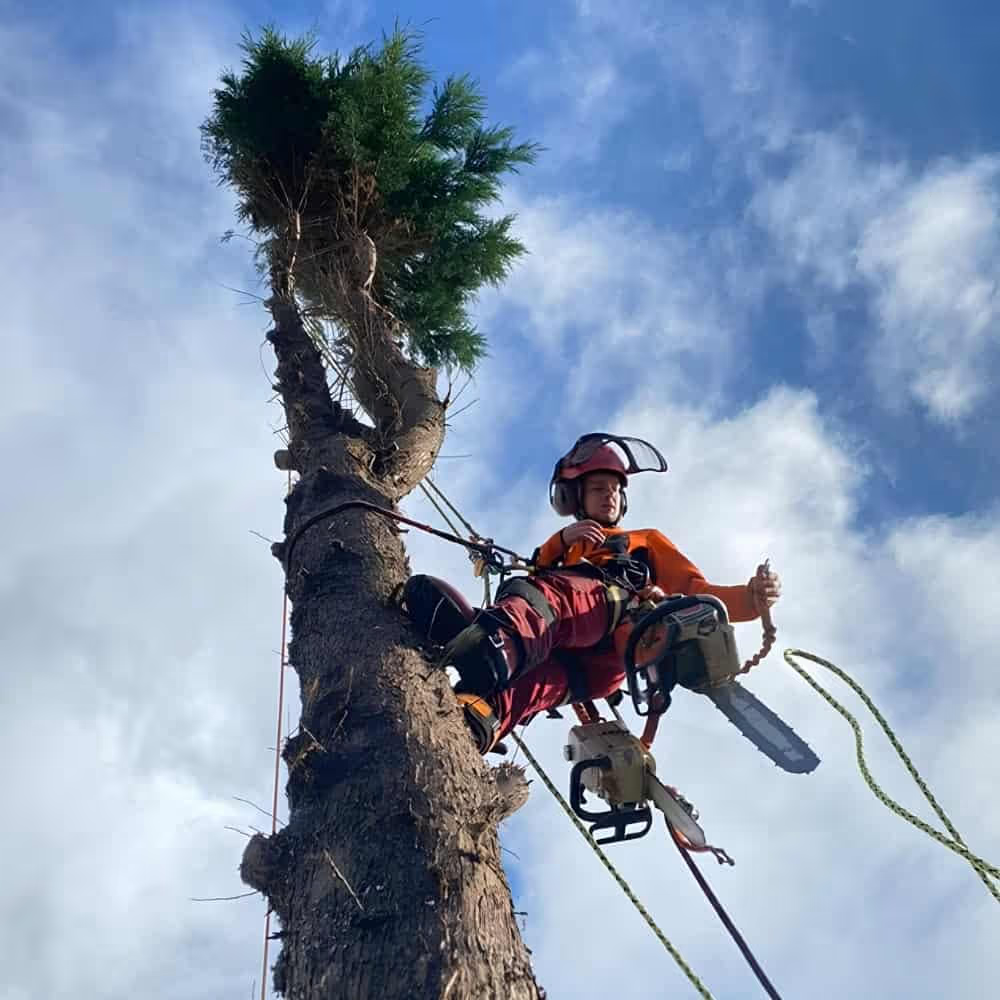
Questions to Ask Before Hiring a Tree Surgeon in Manchester
Choosing a tree surgeon is not just about price. It is about competence, safety, legal compliance, insurance, and whether the work will leave your tree, garden and property in better condition than before.
A good contractor should welcome sensible questions. A poor one will rush you, avoid detail, or make the job sound simpler than it is.
This checklist gives you the questions to ask before hiring a tree surgeon in Manchester, especially if the work involves tree felling, crown reduction, emergency tree removal, commercial tree services, protected trees, difficult access, nearby roads, public footpaths or neighbouring property.
Quick checklist before you hire a tree surgeon
Before you accept a quote, ask:
- Are you insured, and can I see evidence?
- Are the people doing the work qualified for chainsaw use, climbing and aerial tree work?
- Will the work follow British Standard 3998:2010 Tree Work Recommendations?
- Will I receive a written quotation with a clear work specification?
- Who checks whether the tree is protected by a Tree Preservation Order or in a conservation area?
- What happens to the branches, timber, logs and woodchip?
- Are you registered to carry waste?
- How will you protect my lawn, drive, fences, greenhouse, garage, shed and neighbouring property?
- What happens if the job needs traffic management, pedestrian control or access across a public right of way?
- Is the cheapest quote leaving something important out?
The Arboricultural Association’s public guidance makes a similar point: tree work is not directly regulated, so a company can present itself as a tree surgery business even where the necessary credentials are not obvious. Its advice is to check insurance, qualifications, recognised standards, written quotations, references and whether the cheapest quote is truly the best option.
If a contractor cannot answer these questions clearly, don’t proceed.
Why this matters in Manchester and the North West
Tree surgery in Manchester often looks straightforward from the ground. It rarely is.
We’re seeing more gardens where trees sit close to extensions, conservatories, narrow drives, shared alleys, boundary walls and parked vehicles. In the North West we often find wet summers, clay soils, saturated lawns, awkward access tracks, roadside belts and trees growing over public rights of way. Those details change the job.
A small crown reduction over a lawn is one thing. A dismantle over a garage in Didsbury, a roadside sycamore in Stockport, or storm-damaged branches over a footpath in Glossop is another.
The right question is not only, “How much will it cost?”
The better question is, “How will you do this safely, legally and properly?”
If the tree can hit people, property, vehicles or a public route, book a competent contractor.
Question 1: Are you properly insured?
Ask to see current public liability insurance. If the company employs staff, ask about employers’ liability insurance too.
Insurance should match the work. Tree surgery is high-risk work. Branches can damage roofs, fences, vehicles and neighbouring property. A climbing operation over a house, school, commercial site or highway carries more exposure than light pruning in an open garden.
Do not accept vague reassurance such as “we’re fully covered” without evidence. A professional contractor should be able to provide a certificate or policy summary.
The Arboricultural Association recommends checking insurance and notes a minimum public liability level of five million pounds in its homeowner guidance.
If they are reluctant to show insurance, choose someone else.
Question 2: What qualifications do the team hold?
Tree surgery is skilled work. It involves chainsaws, rigging, ropes, climbing systems, lowering equipment, woodchippers, stump grinders and judgement under pressure.
Ask whether the people doing the work hold relevant National Proficiency Tests Council or Lantra certificates for the task. Chainsaw use on the ground is different from chainsaw use in a tree. Tree climbing is different again.
The Health and Safety Executive states that tree climbing operations should only be carried out by people with suitable training, experience and expertise, holding a certificate of competence relevant to the task. It also makes the important point that a certificate is not the same as experience. Inexperienced workers need proper supervision.
That matters. A person can hold a basic certificate and still lack the judgement needed to dismantle a leaning stem over a garage.
Ask this simple question:
“Who will actually be doing the climbing and cutting, and what are they qualified to do?”
If the answer is evasive, don’t use them.
Question 3: Will the work follow British Standard 3998?
British Standard 3998:2010 Tree Work Recommendations is the main United Kingdom benchmark for good tree work.
It matters because poor pruning can damage trees for years. Flush cuts, over-thinning, excessive crown reduction, topping, torn bark and badly placed cuts can create decay entry points, weak regrowth and unnecessary stress.
For crown reduction, the quote should say how much is being reduced and where. “Reduce tree” is not enough.
A better specification would say something like:
“Reduce the crown height and lateral spread by approximately two metres, pruning to suitable growth points, retaining the natural form of the tree, with final pruning cuts in accordance with British Standard 3998:2010.”
That gives the contractor, the client and any Local Planning Authority tree officer something clear to assess.
If the tree is valuable, prominent, mature or protected, insist on a proper specification.
Question 4: Will I receive a written quotation?
Always get the quote in writing.
A proper tree surgery quote should include:
The tree or trees to be worked on.
The work specification.
Whether the work follows British Standard 3998.
The price, including whether value added tax is included.
What happens to branches, timber, logs and woodchip.
Whether stump grinding is included or excluded.
Who checks legal protection.
How the site will be protected.
Any access requirements.
Any exclusions.
The Arboricultural Association specifically advises clients to receive the quote in writing and check that it includes clear details of the work, how arisings will be dealt with, stump details, whether value added tax is included, who checks legal constraints and what steps will protect people and property.
If a quote is just a text saying “cut tree £600”, it is not a professional specification.
Question 5: Who checks whether the tree is protected?
This is one of the most important questions.
Some trees are protected by a Tree Preservation Order. Others are protected because they stand within a conservation area. If so, you normally need written consent or formal notice before works begin.
GOV.UK explains that a Tree Preservation Order can prohibit cutting down, topping, lopping, uprooting, wilful damage and wilful destruction without written consent from the Local Planning Authority. It also states that owners of protected trees must not carry out, cause, or permit prohibited activities without that consent.
In Manchester and Greater Manchester boroughs, this means checking with the relevant Local Planning Authority before work starts. That may be Manchester City Council, Stockport, Trafford, Salford, Tameside, Oldham, Rochdale, Bury, Bolton or Wigan, depending on the site.
Do not assume the contractor has checked.
Ask:
“Will you check whether the tree is protected, and will that be stated in the quote?”
For protected trees, the application or notice should describe the work accurately. Vague descriptions cause delays and refusals.
If the tree is protected, get the paperwork right before anyone starts cutting.
Question 6: What happens to the waste?
Tree work creates a lot of material. Branches, timber, rakings, sawdust, ivy, hedge cuttings and woodchip all need dealing with.
Ask whether the price includes removal. Ask whether logs are being left. Ask whether woodchip is being taken away or tipped on site. Ask whether the contractor is registered to carry waste.
GOV.UK states that businesses must register if they transport waste, buy, sell or dispose of waste, or arrange for someone else to deal with waste.
This is not a small detail. If waste is fly-tipped, it can come back to the person who commissioned the work.
A professional contractor should be clear about arisings before the job begins.
If the quote is cheap because the waste is being left behind, you need to know.
Question 7: How will you manage safety on site?
Tree work can cause serious injury if carried out badly. The Health and Safety Executive describes chainsaws as potentially dangerous machines capable of causing fatal or major injuries and states that operators must be trained and competent for the type of chainsaw work required.
Ask how the contractor will control the work area.
On a domestic site, that may mean keeping children, pets and neighbours away from the drop zone. On a commercial site, it may mean barriers, signage, banksmen, exclusion zones and timed working around staff or customers.
On a roadside or public footpath, it may involve more formal pedestrian or traffic control.
A good contractor will not let people wander underneath the work.
In wet Manchester gardens, ground protection also matters. Heavy timber, tracked machines and repeated foot traffic can damage lawns and compact soil. On tight access sites, a contractor should explain how they will move material without damaging walls, gates, fences, drains or paving.
If the site contains people who cannot easily be controlled, such as school pupils, tenants, residents, customers or members of the public, insist on a written plan.
Question 8: Is crown reduction better than tree felling?
Not always. It depends on the tree, the defect, the objective and the site.
Crown reduction can be appropriate where the aim is to reduce end weight, improve clearance, retain a tree, reduce sail area, or manage a tree within a confined space. It must be specified properly. Over-reduction can ruin structure and appearance.
Tree felling may be appropriate where a tree is dead, structurally compromised, unsuitable for its location, causing unacceptable damage, or impossible to manage safely by pruning.
A good tree surgeon should explain the options. They should not recommend felling every tree because it is easier, and they should not recommend pruning where the tree is clearly beyond sensible retention.
Bartlett Tree Experts make a useful wider point: a good arborist needs knowledge, experience, safety judgement and the confidence to say when a tree presents a concern.
If you love the tree, ask whether retention is realistic.
If you are worried about safety, ask what risk the work is reducing.
A grounded Manchester vignette
On a recent domestic site in South Manchester, a homeowner had three quotes for a mature sycamore overhanging a narrow drive and a neighbour’s garage. The cheapest quote simply said “cut back tree”.
The better quote specified a measured crown reduction, pruning points, waste removal, protection of the driveway, and a check for legal constraints before work started.
The client did not choose the lowest price. They chose the quote that explained the risk.
That was the right decision.
Question 9: What should make you cautious?
Be careful if a contractor:
Knocks on the door and pressures you to decide immediately.
Only accepts cash.
Will not provide insurance evidence.
Will not provide qualifications.
Will not put the quote in writing.
Says protected tree consent is “not worth worrying about”.
Suggests topping a mature tree without good reason.
Cannot explain how waste will be removed.
Cannot explain how the work will be carried out safely.
Gives a price far below everyone else without explaining why.
Cheap work can become expensive. Damage to a roof, a prosecution for unauthorised protected tree works, a neighbour dispute, or a badly pruned tree can cost far more than choosing the right contractor in the first place.
If the answer feels slippery, pause the job.
Question 10: How do I compare tree surgery quotes fairly?
Compare like with like.
One quote may include waste removal, stump grinding, protected tree checks, proper access arrangements and British Standard 3998 pruning. Another may include only cutting and leaving the waste.
One contractor may be insured, trained and equipped for rigging over property. Another may be pricing the job as a quick cut-and-drop.
Ask each contractor to confirm:
The exact work.
The standard of work.
The team’s qualifications.
Insurance.
Waste removal.
Legal checks.
Timescale.
Access needs.
What is excluded.
The cheapest quote is not always wrong. Sometimes a contractor is efficient, local and well organised. But the cheapest quote becomes risky when it leaves out safety, competence, waste, insurance or legal protection.
Choose value, not just price.
Tree surgery Manchester: when to book urgently
Some work can wait. Some cannot.
Book urgent advice if you see:
A split stem.
A hanging branch over a drive, road, footpath or play area.
Recent root plate movement.
A tree leaning suddenly after strong wind.
Large dead limbs over a target.
Fungal brackets with associated decay.
Storm damage above a public route.
In those situations, emergency tree removal or urgent pruning may be needed. The contractor should still consider protected tree rules, but safety-critical situations need prompt professional handling and proper evidence.
Take photographs before work starts. Keep records.
If you see this over a public footpath, drive or play area, book an urgent inspection.
Final hiring checklist
Before you say yes, ask yourself:
Have I seen insurance evidence?
Have I checked qualifications?
Is the quote written and detailed?
Does it refer to British Standard 3998 where pruning is involved?
Has someone checked for a Tree Preservation Order or conservation area?
Is waste removal clear?
Is stump treatment clear?
Is access clear?
Is safety management clear?
Do I understand what I am paying for?
Would I be comfortable showing this quote to a tree officer, insurer, neighbour or property manager?
If the answer is yes, you are probably dealing with a professional.
If the answer is no, ask more questions.
Call to action
Need a professional tree surgery quote in Manchester or Greater Manchester?
Roots and Shoots Arborists provide tree surgery, tree felling, crown reduction, emergency tree removal and commercial tree services across Manchester and the North West. We provide clear written quotations, professional advice, safe working methods and practical guidance where trees are protected.
Contact us to arrange a site visit and get a clear, properly specified quote before work begins.
Disclaimer
This article provides general arboricultural and tree surgery guidance for tree owners in England. It is not legal advice. Tree Preservation Orders, conservation area controls, planning conditions, felling licence rules and site-specific safety duties can vary by circumstance. Always check with the relevant Local Planning Authority before carrying out works to protected trees, and use a competent, insured arboricultural contractor.

Speak to a trusted professional tree surgeon about your trees
Whether you need advice, ongoing maintenance or professional tree work, we offer a free, no-obligation site visit to assess your trees and discuss the best course of action.