
What Qualifications Should a Tree Surgeon Have?
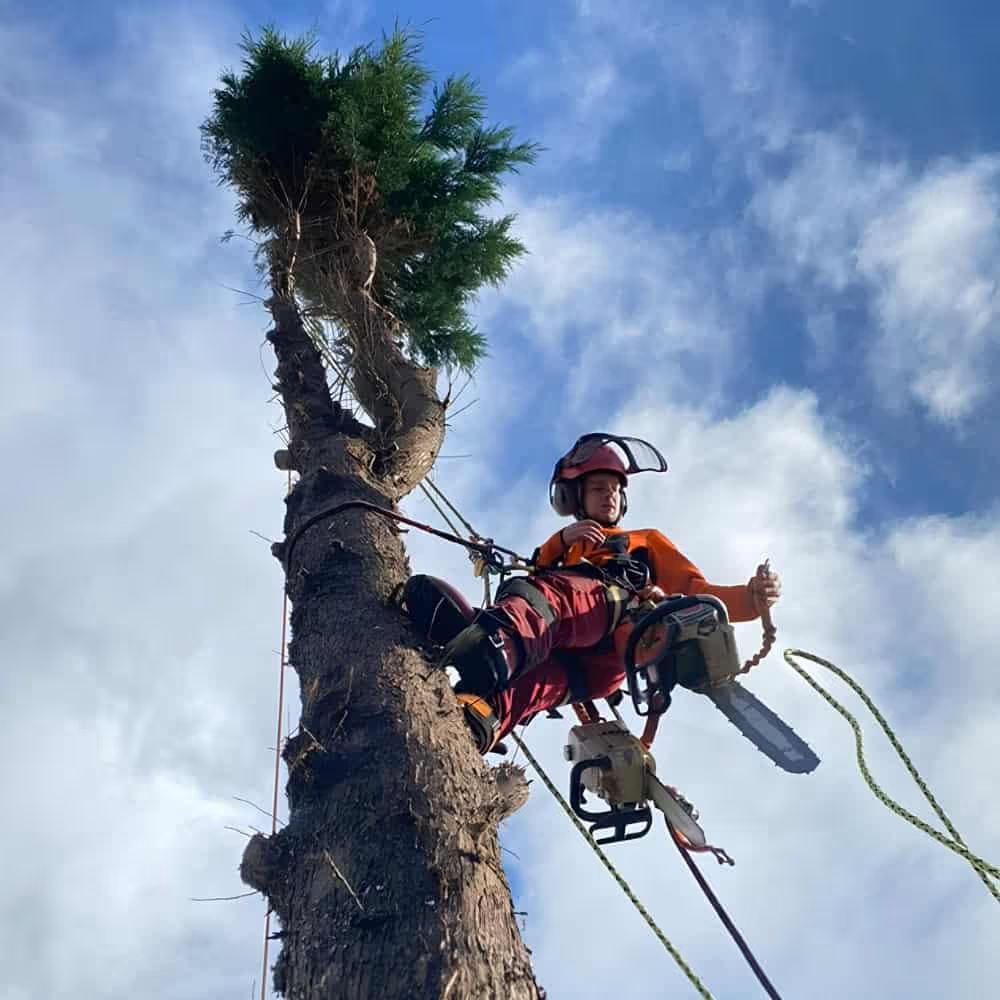
What Qualifications Should a Tree Surgeon Have?
Tree work is easy to underestimate from the ground.
A person with a chainsaw, a ladder and a low price can look convincing. But professional tree surgery is skilled, hazardous work involving tree biology, rigging, machinery, property protection, legal checks and public safety. In the United Kingdom, tree work is not directly regulated in the way many people assume, so it is possible for someone to offer tree surgery services without the right level of competence. The Arboricultural Association makes this point clearly in its public guidance on choosing an arborist.
If you own trees in Manchester, Greater Manchester or the wider North West, the safest approach is due diligence. Ask for proof. Ask what standard the work will follow. Ask who is responsible for checking whether the tree is protected. A good contractor won’t be offended by those questions.
They’ll expect them.
Quick answer: what should you check before hiring a tree surgeon?
Before agreeing to tree felling, crown reduction, sectional tree removal, emergency tree removal or commercial tree services, check that the tree surgeon can provide:
A written quotation with a clear work specification.
Proof of public liability insurance and, where staff are employed, employers’ liability insurance.
Relevant National Proficiency Tests Council or Lantra certificates for chainsaw use, climbing, aerial rescue and any machinery being used.
Confirmation that work will follow British Standard 3998:2010, Tree Work: Recommendations.
A clear plan for timber, branches, woodchip, stump treatment and waste removal.
A site-specific approach to safe working, including rigging branches, protecting property, managing access and controlling public risk.
Confirmation of who will check for Tree Preservation Orders or conservation area restrictions before work starts.
The Arboricultural Association’s public guidance advises clients to ask whether the contractor is insured, whether they work to British Standard 3998, whether staff hold National Proficiency Tests Council or Lantra certificates, and whether a written quotation will be provided. Its quotation checklist also asks what will happen to timber, branches and stumps, whether value added tax is included, and who is responsible for protected tree permission.
Practical line: if a contractor cannot put the job clearly in writing, don’t rely on a verbal promise.
Why qualifications matter when tree work looks straightforward
A small tree can still hurt someone. A medium-sized branch can break a greenhouse, a roof, a wall or a parked car. A large limb over a conservatory, public footpath or narrow Manchester driveway needs planning before any saw is started.
Tree surgery is not just cutting. It is controlled dismantling.
A competent tree surgeon has to understand the tree’s structure, the direction of loading, the strength of anchor points, the limitations of ropes, the reach of machinery, the movement of timber as it is cut, and the effect of pruning on future tree condition. Poor pruning can leave large wounds, torn bark, decay entry points and unstable regrowth. Research on urban tree pruning has repeatedly shown that pruning cuts create wounds and that the size, position and timing of cuts influence discoloration, decay and wound closure.
This is where cheap work becomes expensive.
A poor crown reduction can ruin the shape of a tree. Bad topping can create weak regrowth. Flush cuts can damage the branch collar. Uncontrolled branch removal can tear bark down the stem. Heavy-handed work can leave the tree less safe than before.
Practical line: good tree work should solve a problem without creating a bigger one.
The essential certificates: chainsaws, climbing, rescue and machinery
A tree surgeon does not need a university degree to cut trees professionally. But the people carrying out the work should hold the right practical certificates for the exact task.
The Health and Safety Executive says chainsaws can cause fatal or major injuries and that anyone using a chainsaw at work must have adequate training and be competent for the type of chainsaw work required.
That last phrase matters: “for the type of work required”.
A ground worker cross-cutting timber needs different competence from a climber using a top-handled chainsaw in the crown. A contractor felling a small tree in an open garden is not automatically competent to dismantle a storm-damaged tree over a garage using rigging. A team using a mobile elevating work platform, crane, woodchipper or stump grinder should be trained for that equipment.
Ground-based chainsaw work
For ground-based work, ask whether the operative has relevant certificates for chainsaw maintenance, cross-cutting and tree felling. City and Guilds states that forestry and arboriculture activities need to be carried out legally, safely and competently, with qualifications assessing both practical skills and underpinning knowledge.
For simple garden tree felling, this is the baseline.
It is not the whole story.
The site still needs to be assessed. Are there overhead lines? Is the tree leaning? Is there decay at the base? Is there enough room to fell the tree safely, or does it need to be dismantled in sections? Are there neighbouring sheds, walls, drives, public rights of way or parked vehicles in the drop zone?
Practical line: the right certificate matters, but so does the judgement to know when felling is not appropriate.
Climbing, aerial rescue and cutting in the tree
For climbing work, the questions become more serious. The Health and Safety Executive states that tree-climbing operations must only be carried out by people with suitable training, experience and expertise, holding a relevant certificate of competence. It also makes clear that a certificate is not, by itself, a measure of experience, and that inexperienced workers need proper supervision.
Ask about tree climbing and aerial rescue.
Aerial rescue is not a paperwork exercise. If a climber is injured in the tree, another trained person must be able to reach and recover them. That is why a professional team is not just one person with climbing kit.
Tree climbing must also be properly planned. The Health and Safety Executive guidance on work at height confirms that the Work at Height Regulations 2005 do not ban climbing, but tree work at height must be planned and the right work equipment selected.
Practical line: if someone proposes climbing work alone, that is a serious warning sign.
Woodchippers, stump grinders, rigging and cranes
Tree surgery often uses machinery and lifting systems. Woodchippers, stump grinders, lowering ropes, friction devices, pulleys, mobile elevating work platforms and cranes all introduce additional risks.
Lantra lists tree surgeon training and qualifications including windblown tree work and aerial cutting of trees with a chainsaw and describes these qualifications as requirements for professional chainsaw users in the United Kingdom.
For larger removals, ask how branches will be controlled.
“Sectional tree removal” means the tree is taken down in manageable parts. “Rigging branches” means branches or stem sections are cut and lowered in a controlled way using ropes and equipment. “Using a crane” may be appropriate where very large sections need to be lifted away and ground access allows it. “Using a mobile elevating work platform” may be safer where the tree is unsafe to climb or where access from a working platform gives better control.
The point is not to ask for the most impressive equipment.
The point is to ask why that method is suitable.
Practical line: the safest method is the one that fits the tree, the site and the foreseeable targets.
Insurance: the document many homeowners forget to ask for
Insurance is not a bonus. It is part of basic due diligence.
Ask for current proof of public liability insurance. If the contractor has employees, ask for employers’ liability insurance. The Arboricultural Association’s public checklist refers to employers’ liability and public liability insurance and recommends a minimum public liability level of five million pounds.
For commercial tree services, roadside work, schools, care settings, industrial estates and sites with public access, insurance requirements may be higher. The client may also need risk assessments, method statements, evidence of training, traffic management arrangements and a competence matrix.
Check the name on the policy.
Does it match the company quoting? Does the policy cover tree surgery? Is the expiry date current? Are height work, chainsaw work and the proposed operations covered?
Practical line: don’t accept “we’re insured” as an answer; ask to see the document.
British Standard 3998: what good tree work should be measured against
British Standard 3998:2010, Tree Work: Recommendations, is the key United Kingdom standard for tree work. The British Standards Institution describes it as giving general recommendations for tree work and guidance on management options for established trees, including soil care and tree felling.
For a homeowner, this means the quote should not simply say “cut tree”.
It should specify the work.
For crown reduction, how much is being reduced? Is it two metres, three metres, or a percentage? Is the work to suitable growth points? Are dead, damaged or crossing branches being removed? Are previous poor cuts being tidied where appropriate? Is the objective to reduce end weight, clear a building, manage risk, improve form or provide clearance?
For tree felling, is the stump being left, ground out or treated? Will timber be removed or left on site? Will woodchip be taken away? How will lawns, paving, walls, drains, fences and neighbouring property be protected?
National firms also emphasise pruning standards. Bartlett Tree Experts, for example, discusses the importance of recognised pruning standards and correct pruning decisions, and its technical material stresses proper pruning cuts close to the branch collar rather than leaving stubs or damaging the collar.
Practical line: a professional specification should be clear enough that another competent arborist can understand exactly what has been priced.
Safe working: access, lowering branches, public rights of way and weather
In the North West, site conditions often shape the job.
Wet summers soften lawns and access tracks. Clay soils can hold water and make heavy machinery movement more damaging. Back gardens in Manchester, Stockport, Salford, Trafford and Tameside often have tight side access, narrow drives, conservatories, extensions, overhead cables and boundary walls. Roadside belts and public rights of way add another layer of risk.
A professional contractor should think about all of this before work starts.
How will the team get equipment to the tree? Will ground protection be needed? Can branches be dragged out without damaging planting, paving or fencing? Is there space for a chipper? Is there a safe exclusion zone? Does a footpath need temporary control? Is the work affected by wind?
Aerial tree work is hazardous, and the Health and Safety Executive notes that work off the ground involving lifting and lowering people or loads can fall under the Work at Height Regulations 2005 and the Lifting Operations and Lifting Equipment Regulations 1998.
An anonymised North West example: we recently looked at a garden tree beside a narrow drive, with a greenhouse below and no clean drop zone. A cheap quote proposed simply “taking it down”. The safer decision was sectional removal with controlled lowering, waste removed through side access, and the greenhouse protected before cutting started.
Shorter job? No.
Better job? Absolutely.
Practical line: if there is a target below the tree, ask how each branch will be controlled before it is cut.
Protected trees: who checks permission before work starts?
Some trees cannot lawfully be pruned or felled without prior consent or notice.
A tree may be protected by a Tree Preservation Order. A tree may also be in a conservation area. Government guidance confirms that Tree Preservation Orders can protect individual trees, groups, areas or woodlands, and can apply to trees of any size or species.
The Planning Portal states that a Tree Preservation Order application can take up to eight weeks once accepted as valid, while work to a tree in a conservation area generally requires six weeks’ notice before work starts.
This needs checking before work begins.
In Manchester and surrounding boroughs, local planning authority mapping and records can vary in how easy they are to use. Some properties also sit within conservation areas where owners do not realise additional controls apply. A professional tree surgeon should either check this or tell you clearly that you must obtain independent confirmation before instructing works.
Do not assume emergency tree removal is exempt in every situation. Dead or dangerous tree exemptions are narrow, evidence should be retained, and replacement duties can arise.
Practical line: before any protected tree is cut, get the permission position clear in writing.
Written quotations: what a professional quote should include
A good written quotation protects both sides.
It should include:
The contractor’s name, address and contact details.
The site address.
The tree or trees being worked on.
The species if known.
The exact work specification.
Reference to British Standard 3998:2010.
The price and whether value added tax is included.
What happens to timber, branches, woodchip and stumps.
Who is responsible for checking protected tree status and obtaining consent.
Any access assumptions.
Any exclusions.
Insurance confirmation.
Expected timing, subject to permission and weather.
The Arboricultural Association’s quotation guidance specifically tells clients to check for reference to British Standard 3998, full work details, arrangements for timber, branches and stumps, whether value added tax is included, who is responsible for permission for protected trees, and what steps will protect the client and property.
Practical line: if two quotes are vague, you cannot compare them properly.
Why the cheapest quote is not always the best quote
The cheapest quote may be fine for a simple, low-risk job where the contractor is competent, insured and clear about the work.
But very cheap tree work often hides missing elements.
No written specification.
No protected tree check.
No proper rigging.
No waste removal.
No stump treatment.
No value added tax clarity.
No evidence of insurance.
No relevant certificates.
No plan to protect your property.
No aftercare advice.
That matters because the consequences usually fall on the tree owner. If a protected tree is unlawfully cut, the owner can be drawn into enforcement issues. If waste is fly-tipped, the paper trail matters. If a branch damages a neighbour’s property, the insurance position matters. If the tree is badly pruned, the visual and structural consequences can remain for years.
Cheap work can also be unfair to proper contractors. A professional team has training costs, insurance, equipment inspections, machinery maintenance, waste disposal costs, fuel, staff, personal protective equipment and administration. They also price the time needed to do the job safely.
Practical line: compare competence, method and specification before comparing price.
Local Manchester and North West considerations
Tree Surgery Manchester is not the same as tree work in an open rural field.
Local sites often include terraced streets, narrow rear access, shared drives, boundary disputes, public footpaths, school grounds, commercial car parks, roadside trees and trees close to older housing stock. In parts of Greater Manchester and the wider North West, wet ground conditions can affect access and reinstatement. Clay soils can influence root conditions and site movement. Exposed locations on ridges, valley sides and coastal-influenced weather systems can increase wind loading.
In practice, we’re seeing clients ask better questions. That is a good thing.
A homeowner in Didsbury may need crown reduction over a conservatory. A landlord in Salford may need tree felling where branches overhang a rear alley. A commercial client in Stockport may need weekend works to avoid public access. A school in Trafford may need tree works planned outside drop-off and collection times. Each job needs a method that reflects the site.
Practical line: local experience matters most when access, neighbours and public safety are tight.
Questions to ask before you say yes
Ask these before instructing tree work:
Can I see your insurance certificate?
What National Proficiency Tests Council or Lantra certificates do the team hold for this task?
Will the work follow British Standard 3998:2010?
Will I receive a written quote with a clear specification?
Who checks whether the tree has a Tree Preservation Order or is in a conservation area?
How will branches be lowered or controlled?
Will you use climbing, a mobile elevating work platform, rigging or a crane?
What happens to timber, branches, woodchip and stumps?
How will you protect lawns, walls, drains, roofs, greenhouses and neighbouring property?
What happens if weather conditions make the work unsafe?
Can you provide references or evidence of similar work?
Are you an Arboricultural Association approved contractor or a member of a recognised professional organisation?
Professional membership alone does not guarantee the quality of every cut, but it does show a level of commitment to standards, training and accountability. The Arboricultural Association maintains a directory of approved contractors and says approved contractors are assessed for health and safety procedures, office and business practices, customer care and quality of tree work.
Practical line: a competent contractor will answer clearly, not defensively.
Final advice
The right tree surgeon should be qualified for the task, insured for the risk, clear in writing, aware of protected tree controls and capable of explaining how the work will be done safely.
That is the standard to look for.
For tree owners in Manchester, Greater Manchester and the wider North West, Roots and Shoots can help with professional tree surgery, tree felling, crown reduction, emergency tree removal and commercial tree services. If you need independent advice before instructing works, a tree condition survey or written arboricultural opinion can help you decide what is necessary, proportionate and defensible.
Call to action
Need a qualified tree surgeon in Manchester?
Contact Roots and Shoots for professional advice, a written quotation and tree work carried out to recognised arboricultural standards.
Suggested internal links:
Tree Surgery Manchester / homepage — anchor text: qualified tree surgeon in Manchester
Contact page — anchor text: request a written tree surgery quote
Tree felling — anchor text: professional tree felling in Manchester
Crown reduction — anchor text: crown reduction carried out to British Standard 3998
Emergency tree removal — anchor text: emergency tree removal after storm damage
Commercial tree services — anchor text: commercial tree services for schools, estates and businesses
Frequently asked questions
What qualifications should a tree surgeon have in the United Kingdom?
A tree surgeon should hold the relevant National Proficiency Tests Council or Lantra certificates for the exact work being carried out. This may include chainsaw maintenance, cross-cutting, tree felling, tree climbing, aerial rescue, aerial cutting, woodchipper use, stump grinder use, mobile elevating work platform operation and specialist rigging. The Health and Safety Executive also stresses that training alone is not enough; the person must be competent for the task.
Does a tree surgeon need to be insured?
Yes. You should ask for proof of public liability insurance and, where the contractor employs staff, employers’ liability insurance. Check that the policy is current, in the correct business name and covers tree surgery operations.
Should tree work follow British Standard 3998?
Yes. British Standard 3998:2010 is the main United Kingdom recommendation standard for tree work. It provides guidance on management options for established trees, including pruning and felling.
Can I prune or fell a protected tree?
You may need consent if the tree is protected by a Tree Preservation Order, or you may need to give notice if the tree is in a conservation area. The Planning Portal states that Tree Preservation Order applications can take up to eight weeks, and conservation area notices generally require six weeks before work starts.
Is the cheapest tree surgeon quote a bad idea?
Not always. But a cheap quote should still include qualifications, insurance, a clear specification, waste arrangements, protected tree checks and safe working methods. If those details are missing, the quote is not genuinely comparable.
Disclaimer
This article provides general arboricultural information for tree owners in England. It is not legal advice and should not be treated as a site-specific tree safety assessment. Tree Preservation Order and conservation area controls vary by local planning authority, and emergency exemptions should be handled carefully with evidence retained. Always obtain competent arboricultural advice before undertaking significant pruning, tree felling or works near people, property, highways or public access.

Speak to a trusted professional tree surgeon about your trees
Whether you need advice, ongoing maintenance or professional tree work, we offer a free, no-obligation site visit to assess your trees and discuss the best course of action.