
What Should Be Included in a Professional Tree Surgery Quo
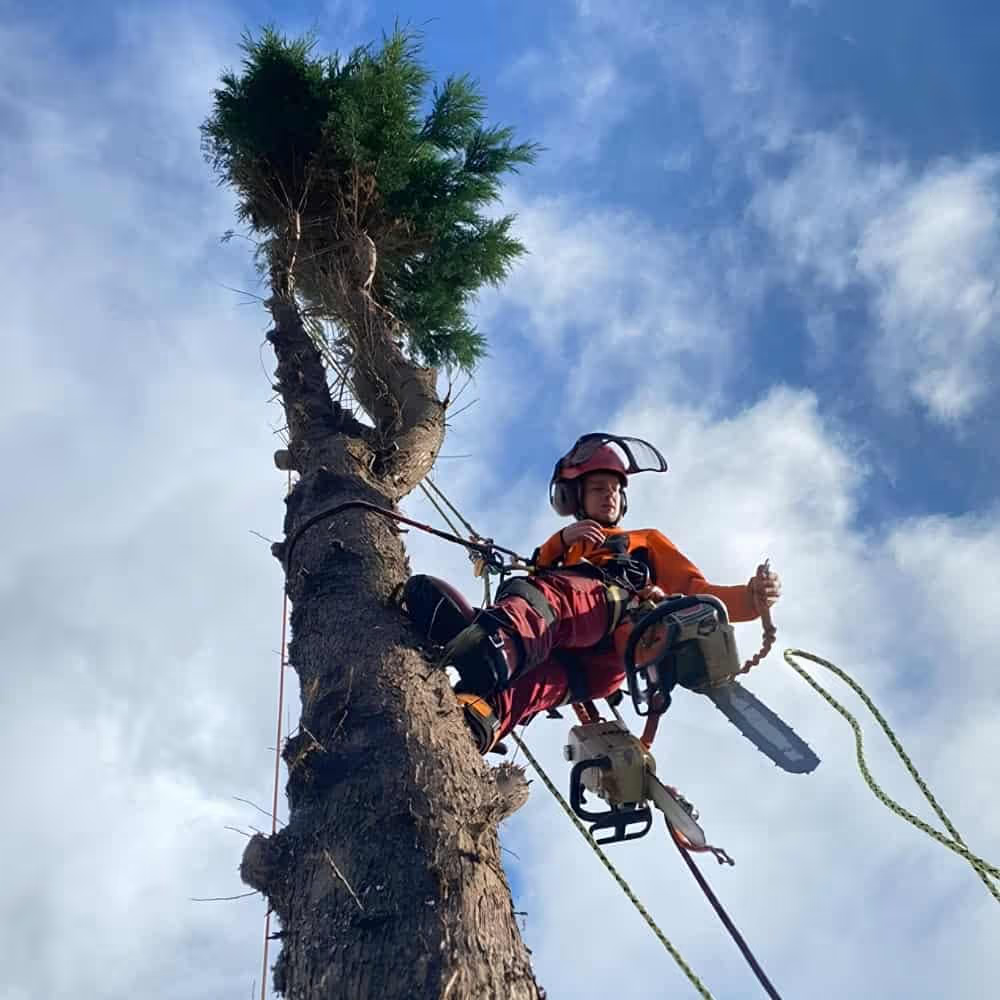
What Should Be Included in a Professional Tree Surgery Quote?
A professional tree surgery quote should tell you much more than the price. It should explain what work will be done, how it will be done, who is responsible for legal checks, what standard the work will meet, and what happens to the timber, branches, stump and debris afterwards.
That matters because tree work is not ordinary garden maintenance. A poor specification can lead to avoidable damage, unsafe work, prosecution for protected trees, or pruning that harms the tree for years.
The Arboricultural Association’s public guidance is direct on this point: tree work is not directly regulated, so clients need to ask the right questions before appointing a contractor. Its own quotation checklist includes reference to British Standard 3998, clear work details, timber and brushwood disposal, stump treatment, value added tax, protected tree permissions and property protection measures.
Quick answer: what should a good tree surgery quote include?
A professional tree surgery quote should include:
A written specification for each tree.
The species or clear tree identification.
The location of the tree on site.
The proposed work, such as tree felling, crown lifting, crown reduction, deadwood removal, sectional tree removal or stump grinding.
A statement that work will follow British Standard 3998:2010 Tree Work. Recommendations.
Confirmation of public liability insurance and, where relevant, employers’ liability insurance.
Evidence of competence, such as Lantra Awards or National Proficiency Tests Council certificates for chainsaw use, climbing, aerial rescue, rigging, pruning or use of a mobile elevated work platform.
Who checks Tree Preservation Order or conservation area status.
Who submits the council application or notice where required.
How branches, timber, woodchip and arisings will be dealt with.
Whether stump removal is included.
How access, public safety, neighbouring property and fragile surfaces will be protected.
The price, whether value added tax is included, and the payment terms.
A cheap line saying “cut tree” is not a professional specification. It is a risk.
If the quote does not say exactly what is included, ask before you accept it.
Why a written quote matters
A written quote protects both sides. It gives the tree owner a clear basis for comparison and gives the contractor a defined scope of work.
This is especially important when you are comparing two or three tree surgery quotes. One contractor might be pricing a careful crown reduction to suitable growth points. Another might be pricing a crude height reduction. One might include removing all branches and timber. Another might leave logs stacked on site. One might include obtaining council permission. Another might assume you have already done it.
Those are not like-for-like quotes.
The Arboricultural Association recommends receiving the quote in writing and checking that the specification is clear before choosing a contractor. It also advises asking whether the contractor is insured, qualified, works to British Standard 3998, belongs to a professional organisation and can provide references.
If a contractor cannot put the work clearly in writing, that is a warning sign.
Tree identification and work specification
A good quote should identify the tree or trees clearly. That can be done by species, position, tree number, sketch plan, annotated photograph or a short description such as “mature sycamore to rear boundary adjacent to garage”.
For small domestic jobs this does not need to be complicated. But it must be clear.
For example:
“Rear garden birch: crown lift to provide approximately 2.5 metres clearance over lawn and footpath, removing secondary branches only, pruning cuts not to exceed approximately 75 millimetres unless agreed on site.”
That is much better than:
“Lift tree.”
For tree felling, the quote should say whether the tree will be felled in one piece, dismantled in sections, rigged down, removed using a mobile elevated work platform, or removed with crane assistance. Where buildings, sheds, greenhouses, public rights of way, highways, overhead lines or neighbouring gardens are involved, sectional tree removal is often the professional option.
For crown lifting, the quote should define the clearance required and where it applies. Lifting over a driveway is not the same as lifting over a public footpath, a school entrance, a parked car area or a commercial loading bay.
For crown reduction, the quote should describe the intended end result. A proper specification may refer to reducing selected branch ends by a measured amount, retaining natural crown form, and pruning to suitable secondary growth points. Bartlett Tree Experts’ structural pruning guidance makes the wider point that pruning is not simply cosmetic; it is used to develop and maintain more stable trees, particularly near buildings, pavements and parking areas.
If the work affects a high-use target, such as a drive, pavement, play area or public right of way, get the specification in writing.
British Standard 3998 and pruning quality
British Standard 3998:2010 Tree Work. Recommendations is the main United Kingdom standard for tree work. The British Standards Institution lists it as the current standard, published on 31 December 2010, and identifies its subject areas as including tree surgery, pruning, occupational safety, arboriculture, nature conservation and safety measures.
For a tree owner, the practical point is simple. Your quote should say that work will be carried out in accordance with British Standard 3998:2010.
That phrase is not decoration. It signals that the contractor understands accepted arboricultural practice. It also helps avoid damaging work such as topping, excessive crown removal, flush cuts, large unnecessary wounds or poor branch-end cuts.
Research on pruning supports this caution. Clark and colleagues reviewed the research foundation for tree pruning and highlighted pruning as a technical subject requiring a biological and structural understanding of trees. Fini and colleagues also studied repeated pruning methods on urban trees and measured effects on growth, physiology and dieback, reinforcing that pruning method matters, not just the amount removed.
A good quote does not just say “reduce tree”. It explains how much, where, and to what standard.
Insurance, competence and qualifications
Tree surgery involves chainsaws, climbing systems, ropes, lowering equipment, ladders, vehicles, chippers and sometimes heavy timber over buildings. Insurance and competence are not optional extras.
A professional quote should confirm public liability insurance. Where the company employs staff, employers’ liability insurance should also be in place. For larger commercial tree services, schools, estates, housing associations and facilities management sites, clients often ask for insurance certificates, risk assessments and method statements before work begins.
The contractor should also be able to show relevant competence. Lantra lists awards covering tree access using rope and harness, aerial rescue, aerial cutting with a chainsaw, aerial tree pruning, aerial tree rigging and chainsaw use from a mobile elevated work platform. Lantra describes several of these qualifications as requirements for professional users carrying out aerial tree work or operating chainsaws in the United Kingdom.
A grounded example from recent domestic work: in South Manchester, we looked at a conifer line over a narrow rear access with garages, parked vehicles and a neighbour’s glasshouse close by. The lower price assumed straightforward cutting and dragging through the house. The better quote allowed for controlled sectional removal, boards to protect surfaces, a smaller chipper, and a written plan for timber. It was not the cheapest. It was the safer, clearer quote.
Ask for proof of insurance and relevant certificates before work starts.
Safe working, access and specialist equipment
A professional quote should consider how the site will actually be worked.
In Manchester and the North West, we often find narrow side passages, terraced access, wet lawns, clay soils, sloping gardens, roadside belts, old boundary walls and trees overhanging public rights of way. Wet summers can leave soft ground. Coastal exposure and Atlantic weather systems can increase wind loading. These details affect the method, the time required and the price.
Some jobs need rigging branches down in sections. Some need a mobile elevated work platform because climbing is unsuitable. Some need traffic management, temporary barriers or a second grounds person to manage pedestrians. Some need a crane where large timber cannot be safely lowered into a confined space.
The Health and Safety Executive describes aerial tree work as hazardous and notes that work off the ground involving lifting and lowering people or loads falls under the Work at Height Regulations 2005 and the Lifting Operations and Lifting Equipment Regulations 1998. Its tree work pages also identify safety topics including aerial work, chainsaws, machinery, working at height, vehicles, training, lone working, public safety, first aid and traffic management.
This is why two quotes can vary widely. The cheap quote may not include the safe method.
If the tree is close to people, buildings, roads or utilities, ask how the work will be controlled.
Waste removal, timber, stumps and site clean-up
A professional quote should say what happens to the material created by the work.
Will branches be chipped and removed?
Will logs be left on site?
Will timber be cut into manageable sections?
Will raking’s and sawdust be cleared?
Is stump grinding included?
Will the stump be cut low to ground level if grinding is not included?
Will the contractor remove arisings from the front drive, rear garden, highway edge or commercial yard?
These details matter. A quote for tree felling may look attractive until you realise it leaves a large stump, a pile of timber and several cubic metres of branches for you to deal with.
For crown lifting and crown reduction, the arisings may be modest. For sectional tree removal, large dismantling work or emergency tree removal after storm damage, waste handling can be a major part of the job.
Make sure the quote says whether the site will be left clear.
Protected trees and council permission
Before tree felling, crown lifting, crown reduction or major pruning, you need to know whether the tree is protected.
In England, a Tree Preservation Order can protect individual trees, groups of trees, areas of trees or woodlands. Government guidance states that a Tree Preservation Order prohibits cutting down, topping, lopping, uprooting, wilful damage and wilful destruction without the local planning authority’s written consent. The guidance also states that owners of protected trees must not carry out, cause or permit prohibited activities without consent.
Government guidance also explains that you may need to make a works to trees application if a tree is protected by a Tree Preservation Order or if you live in a conservation area. Work can include trimming, topping, uprooting or lopping branches.
Your quote should say who is responsible for checking this. Is the contractor checking the local planning authority map? Are you expected to do it? Is an application included? Is there an extra fee for the paperwork?
This is not a box-ticking issue. If protected tree work is carried out unlawfully, the tree owner can be exposed to enforcement action.
Check protected tree status before accepting the start date.
Why the cheapest quote is not always the best quote
The cheapest quote is not automatically wrong. A small, simple job with easy access may be straightforward.
But a very low quote should make you pause.
It may exclude waste removal. It may omit stump grinding. It may rely on unsafe access. It may not include proper insurance. It may not include protected tree checks. It may describe the work so vaguely that you cannot hold anyone to the agreed standard.
A strong quote usually reflects more than labour. It reflects competent people, maintained equipment, insurance, training, disposal costs, traffic or pedestrian control, planning checks, risk assessment, and the time needed to do the work without damaging the tree, property or public realm.
This is particularly important for tree surgery in Manchester, where trees often stand close to houses, garden rooms, extensions, rear alleys, boundary walls and parked vehicles. A crown lift over a drive in Didsbury, a tree felling job behind a terrace in Salford, and emergency tree removal beside a road in Stockport are not the same operational problem.
Good tree work costs what it costs because risk has been understood, priced and controlled.
Compare the scope, not just the total.
Questions to ask before accepting a tree surgery quote
Ask these before you agree:
Is the quote in writing?
Does it identify each tree clearly?
Does it say the work will follow British Standard 3998:2010?
Does it specify the amount of pruning or the method of removal?
Are public liability and employers’ liability insurance in place?
Are the climbers and chainsaw operators qualified for the work proposed?
Will branches, timber and woodchip be removed?
Is stump grinding included or excluded?
Who checks for a Tree Preservation Order or conservation area status?
Who submits the council application or notice?
How will lawns, drives, walls, fences, neighbouring land and public routes be protected?
What happens if nesting birds, bats or other protected wildlife are found?
When can the work start, and is that subject to council consent?
Two practical checks help straight away. First, compare photographs of the tree from the last two summers so you can show any decline, storm damage or branch loss. Second, mark up a phone photograph with the branch or crown area you want dealt with, then ask the contractor to translate that into proper arboricultural wording.
If the answer is vague, do not accept the quote yet.
When you should book a professional site visit
A remote quote can work for very small jobs if the photographs are clear and access is simple. For most tree surgery, a site visit is better.
Book a site visit where the tree is large, close to buildings, protected, difficult to access, near a public footpath, over a road, in poor condition, storm damaged, or where you need a defensible written specification for a tree officer, landlord, insurer, school, estate or commercial client.
For commercial tree services, a site visit is usually essential. The contractor may need to plan working zones, public exclusion, vehicle access, staff parking, emergency arrangements, noise timing, waste handling and communication with site users.
A proper visit often saves money because it prevents misunderstanding.
If you want like-for-like quotes, get the same written specification priced by each contractor.
Call to action
Need a professional tree surgery quote in Manchester or the North West?
Roots and Shoots can provide clear written quotations for tree felling, crown lifting, crown reduction, emergency tree removal and commercial tree services. We can also advise on Tree Preservation Orders, conservation area restrictions, British Standard 3998 work specifications and when a separate tree condition survey is sensible.
Contact us through the website to arrange a site visit and receive a written, properly specified quote.
Frequently asked questions
Should a tree surgery quote be in writing?
Yes. A written quote should set out the tree, the work, the standard, the price, waste arrangements, stump treatment, insurance position and who is responsible for protected tree checks. The Arboricultural Association specifically advises clients to receive the quote in writing and check the specification before accepting.
What does British Standard 3998 mean in a tree surgery quote?
British Standard 3998:2010 Tree Work. Recommendations is the current United Kingdom standard for tree work. In a quote, it means the contractor is committing to recognised arboricultural recommendations for tree pruning, felling and related work.
Do I need permission to cut back a protected tree?
You may need consent if the tree is protected by a Tree Preservation Order or if it is in a conservation area. Government guidance states that protected tree works can require a formal application or notice to the local planning authority.
Why are tree surgery quotes so different?
Quotes vary because contractors may be pricing different methods, waste arrangements, access requirements, insurance, staff competence, equipment, council paperwork, stump treatment and safety controls. A sectional dismantle using rigging or a mobile elevated work platform will cost more than simple ground work.
Is the cheapest tree surgery quote a bad idea?
Not always, but it should be checked carefully. If the cheapest quote is vague, lacks insurance detail, ignores protected tree status, excludes waste removal or does not mention British Standard 3998, it is not a reliable comparison.
Short disclaimer
This article provides general guidance for tree owners in England. It is not legal advice and does not replace site-specific arboricultural assessment. Tree Preservation Order and conservation area rules should be checked with the relevant local planning authority before work begins. Wildlife legislation can also affect timing and method, particularly where nesting birds, bats or other protected species are present.

Speak to a trusted professional tree surgeon about your trees
Whether you need advice, ongoing maintenance or professional tree work, we offer a free, no-obligation site visit to assess your trees and discuss the best course of action.